


See Winston Churchill’s paintings and understand the man
See Winston Churchill’s paintings and understand the man

Charles MooreFri, July 31, 2026 at 4:45 PM UTC
0
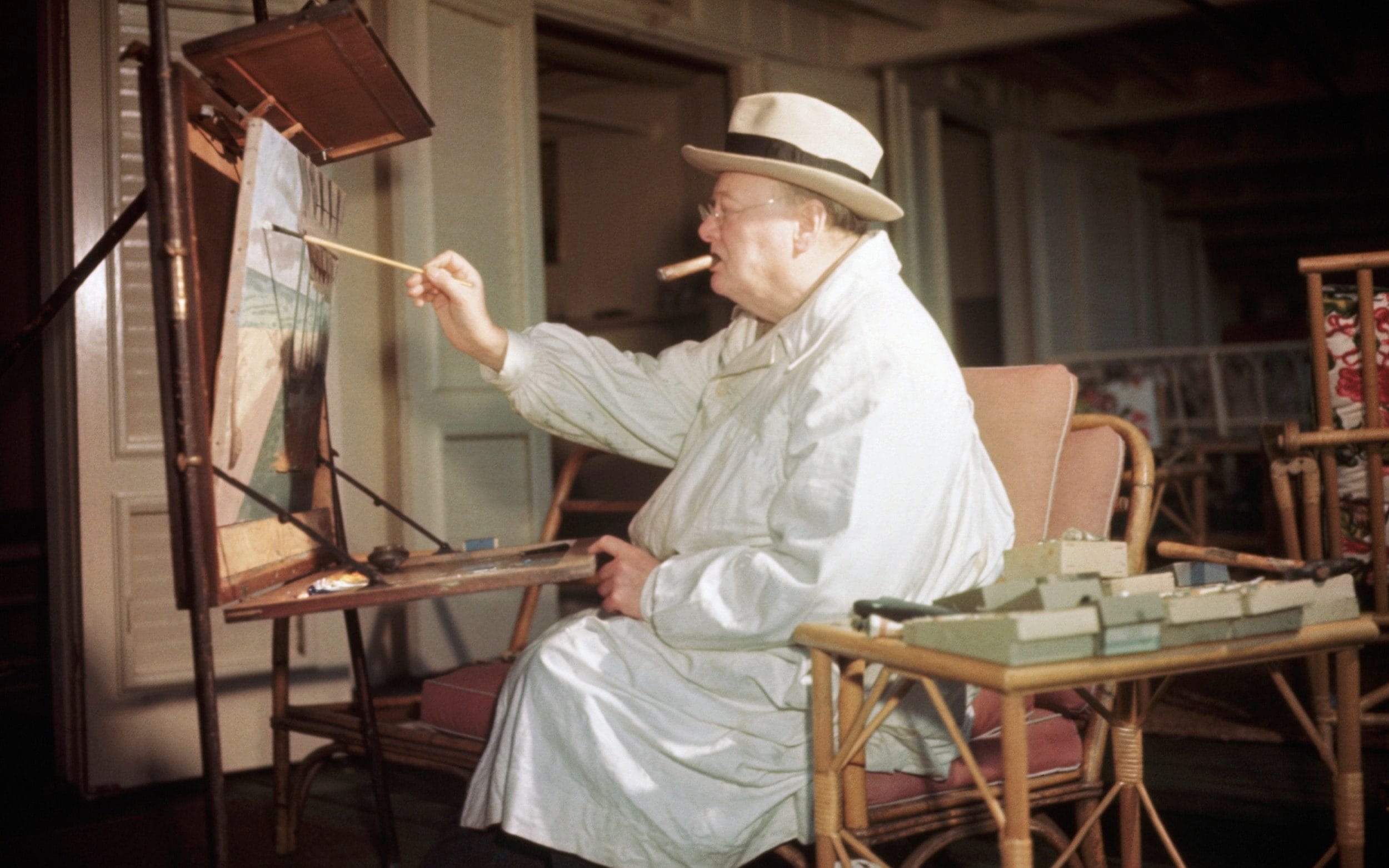
Churchill needed a hobby that combined brain power and physical activity - Bettmann
“Go out into the sunlight and be happy with what you see.” That seems a good piece of general wisdom. But the man who wrote those words was speaking specifically of learning to paint. He was Winston Churchill, who began to learn when he was 40.
Just now, with this atrocious heat in southern England, I have not felt like following Churchill’s advice. Walking down a city street, or even a country lane, is a struggle. So the best way of entering into that Churchillian spirit is to leave the sunlight and descend, as I did this week, to the cool, air-conditioned basement of the Wallace Collection in London. There is an outstanding exhibition which shows how the great man put his sunlight beliefs into practice. It is called Winston Churchill, The Painter.
I have sometimes wasted time debating with myself and others whether Churchill was a good painter. Obviously, he was not, if you compare him with the great artists. As I say, he began late, and he had, to put it mildly, other things to do. But that misses the point. His inspiring essay on the subject is not boastfully called My Art or How to Paint. It makes no high claims. It is called Painting as a Pastime. What this show at the Wallace reveals is how well and happily he passed that time.
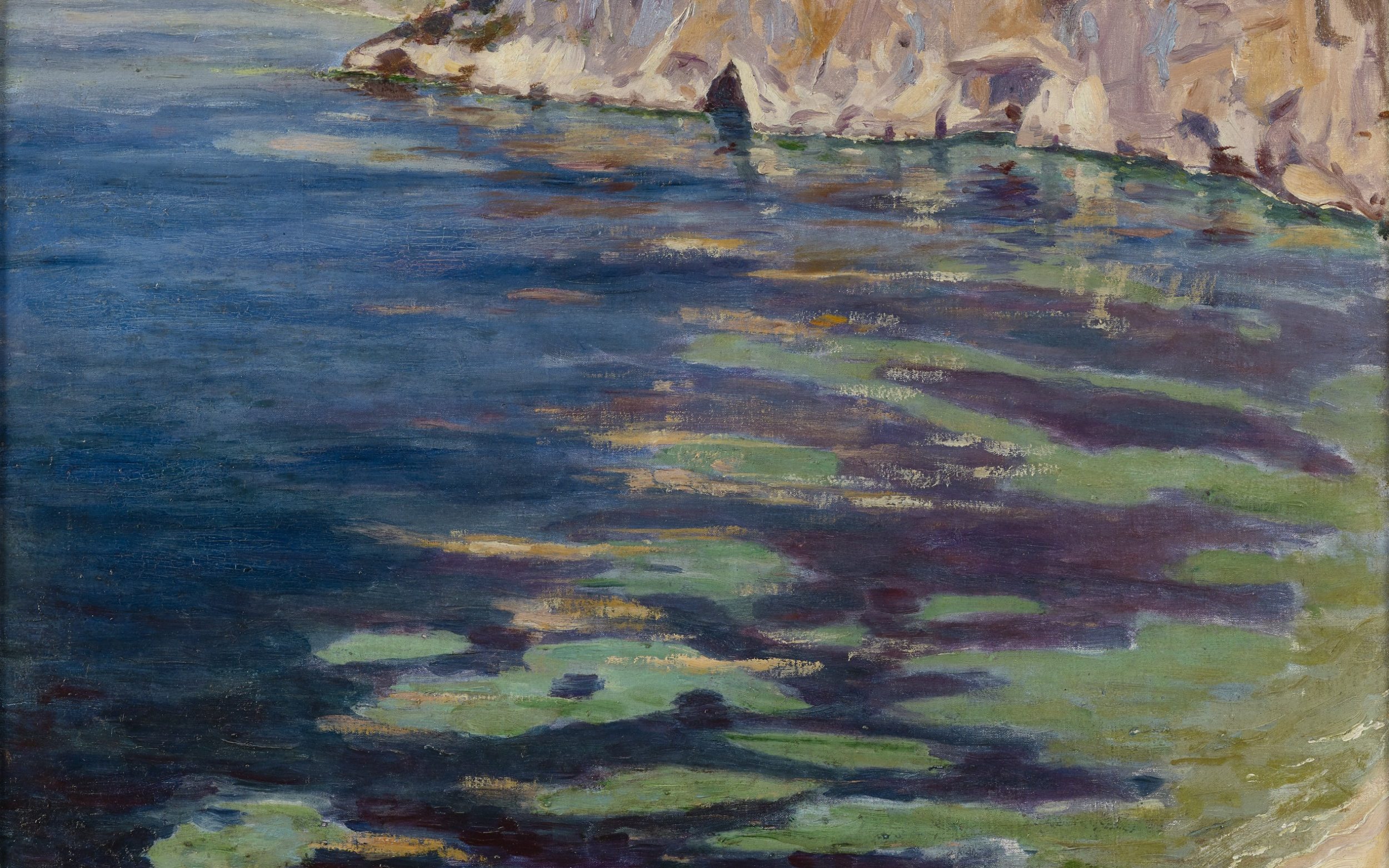
La Mala, Cap d’Ail painted by Churchill in 1921
Hitler was a painter too. Indeed, it was as a would-be professional painter that he was rejected by the Vienna Academy – a decision which, though entirely justified, turned out to have catastrophic consequences. The embittered young Adolf became the vengeful and murderous Führer. I have often wished someone would put on a joint retrospective of his and Churchill’s work. It would show greatly to Churchill’s advantage. Hitler’s stiff, usually architectural efforts are deadly; Churchill’s works are full of life.
It speaks well of anyone that he or she can enjoy a pastime and communicate that enjoyment. In the case of Churchill, one cannot understand his achievements in every field without recognising that enjoyment played a part in all of them – as reporter, author, soldier and statesman. Even when the hour was very dark, his zest for life never left him. “I must say I like bright colours,” he wrote. For him, that was true both literally and metaphorically.
I like to think that if things had been the other way round and he had been a professional painter and only a part-time MP (as was possible in those days), Churchill could have written an equally brilliant essay called Politics as a Pastime. It was not that he was a dilettante – almost no one was ever more industrious – but that the pleasure principle was always at work.
For Churchill, it all began in 1915 when, because of clashes over his Gallipoli scheme, he was removed from the Admiralty but stayed in the Cabinet. He was “placed cruelly in the front seat”, as he put it. “I knew everything and could do nothing.” Painting, specifically painting in oils – “a medium…which offers real power” and permits “Audacity” (he used the capital A for this beloved concept) – was his escape.
Not much later, saddened by everything that had gone wrong, he temporarily left Parliament and politics to serve as an officer at the Western front. There, morose among the explosions, he painted; when he had painted, he cheered up. He compared painting to fighting a battle, because of the need for “a good plan”. Three of the exhibition’s nearly 60 pictures are of Flanders.
Advertisement
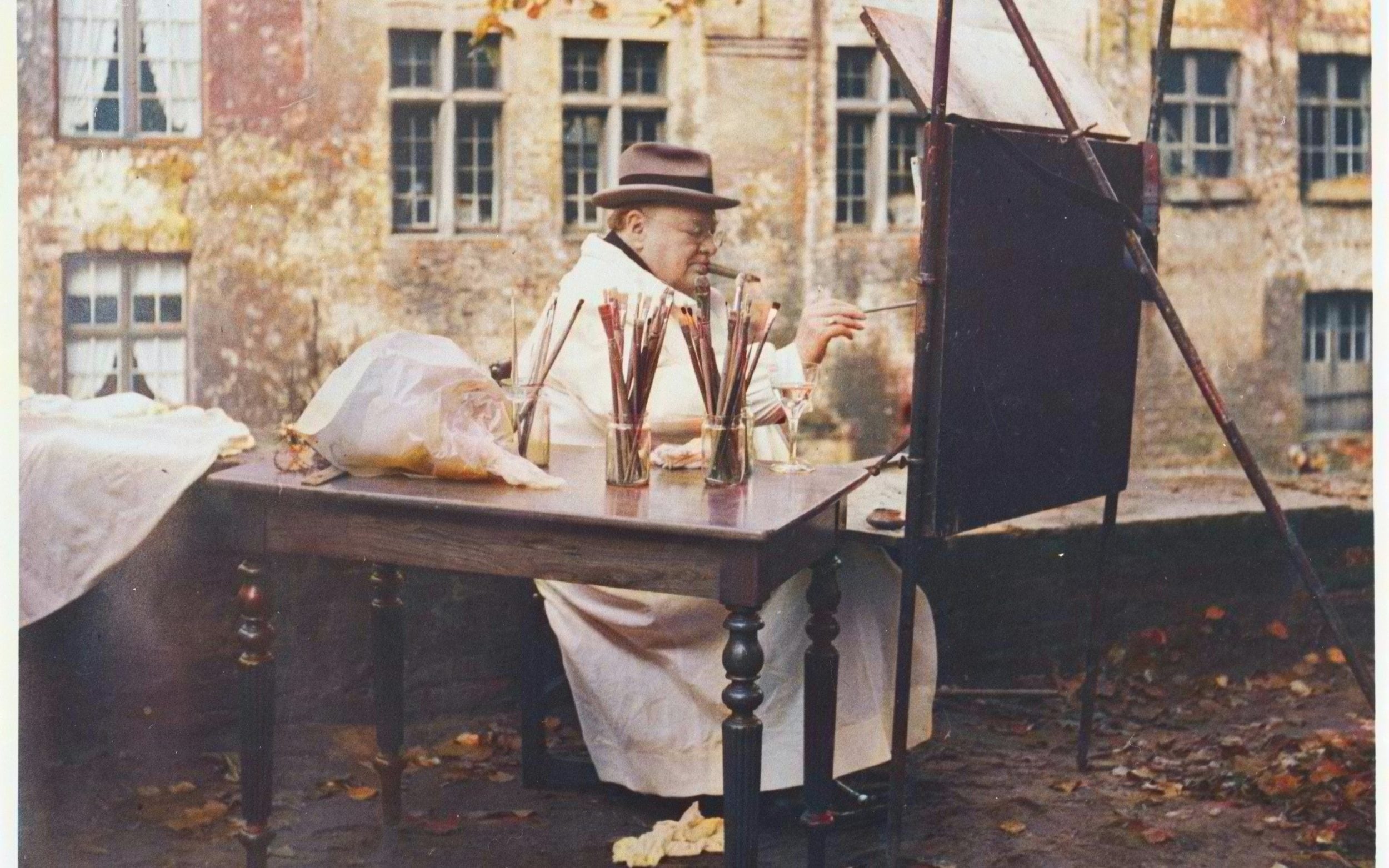
Churchill paints in Belgium. Three of the exhibition’s nearly 60 pictures are of Flanders
Churchill had what might be called a confident humility about painting. He knew he knew nothing about it when he started, but he was not shy of admitting this or of asking for help from the masters of the day – John Lavery, William Nicholson, Walter Sickert and what he called “disciples of Cezanne”.
As you enter the exhibition, you see Churchill’s Flowers, Painted in the Studio at Chartwell hanging beside Nicholson’s Summer Flower Piece, both painted in the 1930s. I admitted to the museum’s director, Xavier Bray, that I thought the Churchill more arresting, if less accomplished, than the Nicholson. He told me several visitors had said the same.
Clever and literary though Churchill was, he was a man of action rather than an intellectual, but his interest in painting was more than a relaxing hobby, such as golf. He wanted something which needed both brain power and physical activity. Painting, he wrote, uses “the parts of the mind which direct both eyes and hand”. His delight in painting made him look at the world afresh. When he looked, he liked what he found. He realised that, when you paint, you encounter “a sunlit garden gleaming with light and colour of which you have the key”. To turn the light which your eye had seen into paint which your hand had applied to canvas was like “a cryptogram deciphered”.
Much as he admired Cézanne’s ability to make even a blank wall an object of fascination, Churchill the amateur preferred more easily pleasing subjects, not least because painting was also “a spur to travel”. He loved hot, sunny places and the light he saw in them – the south of France, Palestine, Egypt and, perhaps above all, Morocco.
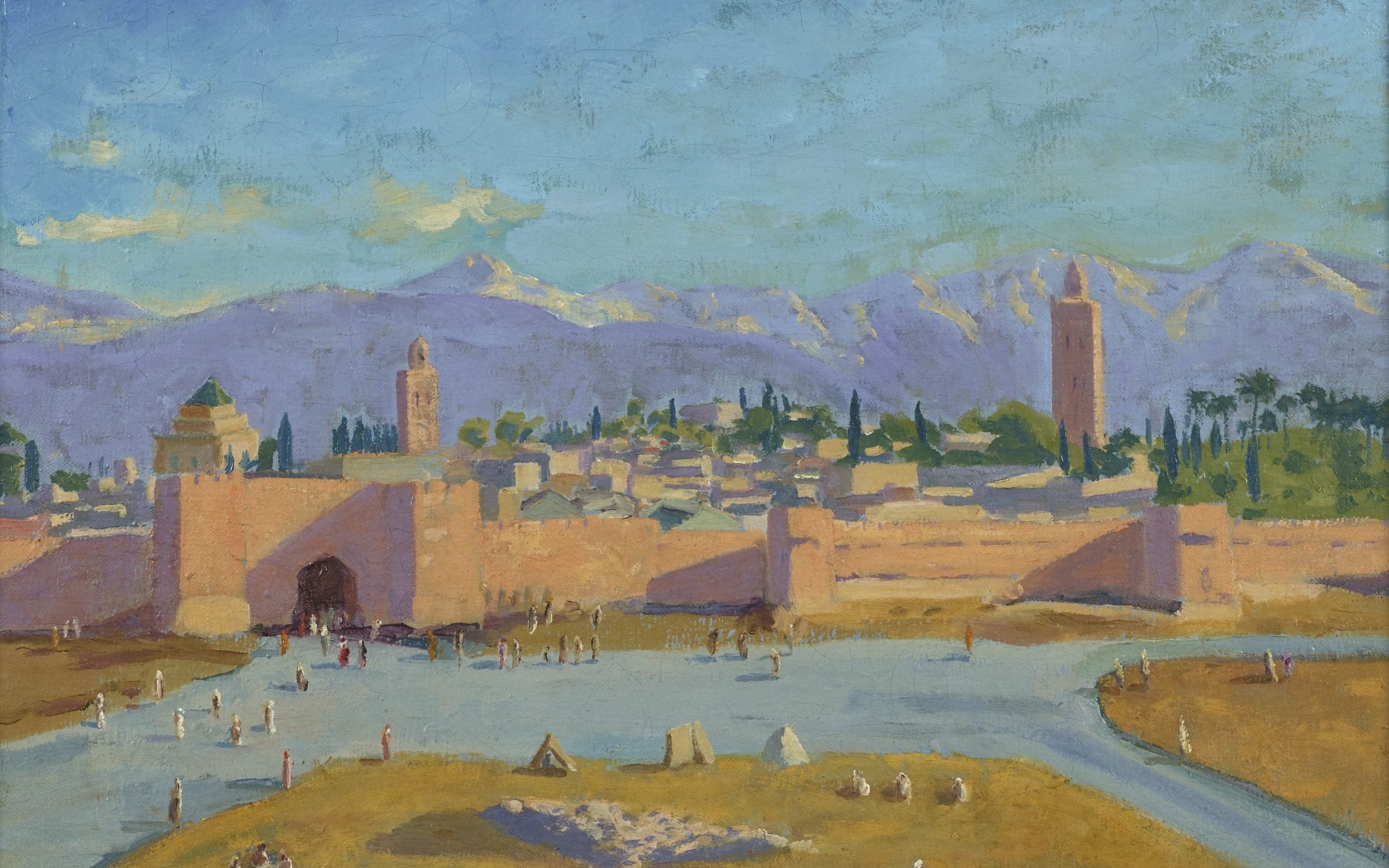
The Tower of the Koutoubia Mosque
At the Casablanca conference in 1943, Churchill dragged Franklin Roosevelt off to Marrakesh to see the sun set over the Atlas mountains from the roof of the Mamounia Hotel, painted the scene after the US president had left and then gave him the result, thus killing three birds with one stone. He loved the place, he painted it, and he used the result to gain “soft power” over his country’s most important wartime ally. The painting (The Tower of the Koutoubia Mosque) was much later owned by Brad Pitt and Angelina Jolie and was sold for £8.3m after their divorce. It has pride of place in the show.
Part of the pleasure of the exhibition lies in seeing via the pictures how well Churchill managed to live his life. Despite the great struggles of war and politics, he could boast, like the Psalmist: “The lines have fallen unto me in pleasant places.” Here he is painting his birthplace, Blenheim Palace, or Wilton, Knebworth, Cranborne, or his own dear Chartwell, or staying with press proprietors in their French villas. His painting of Lord Rothermere’s La Dragonnière at Cap Martin, looking up through the olive groves to the house, is one of his best.
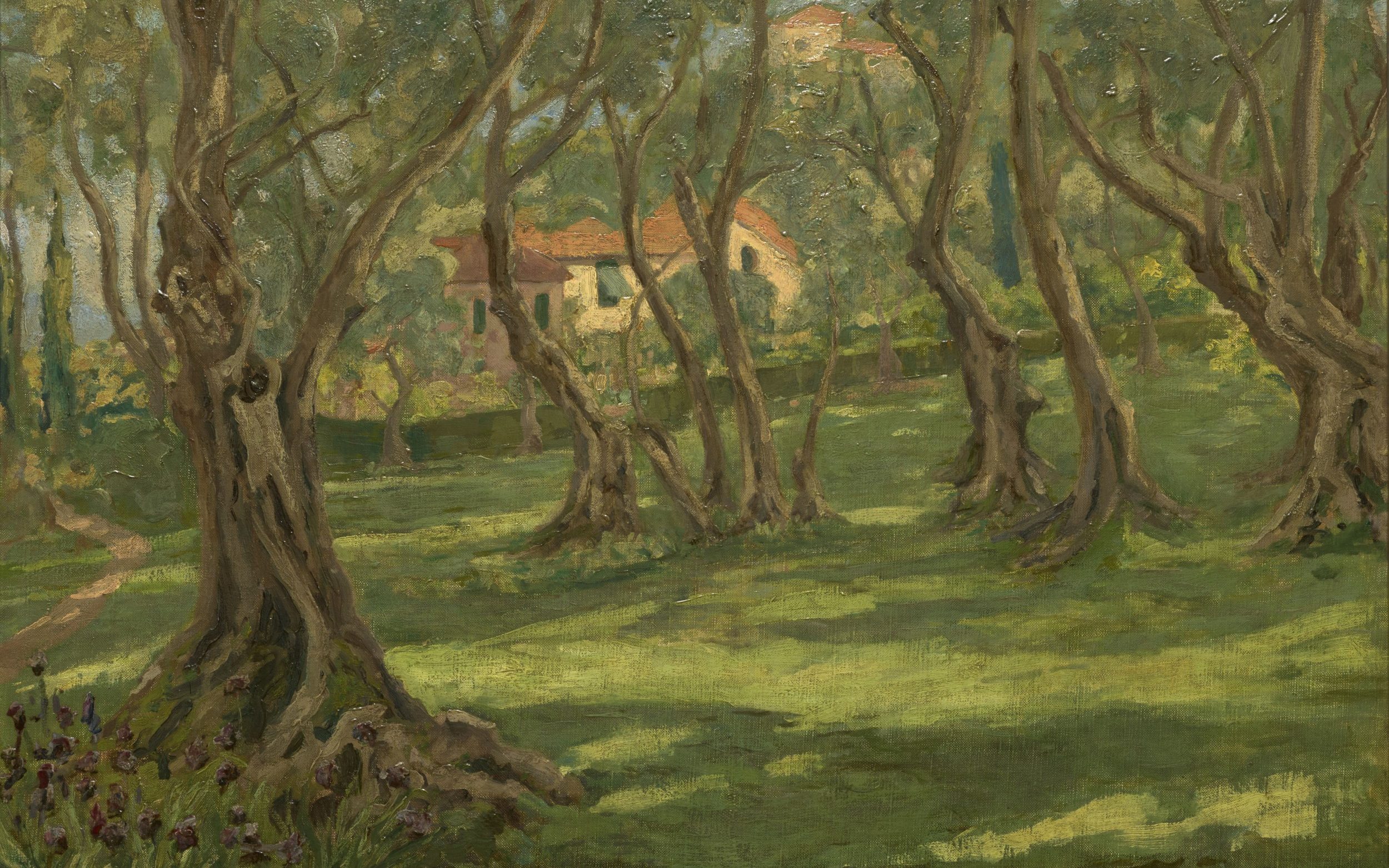
La Dragonnière, Cap Martin
Churchill never painted commercially, except for one brief period under the pseudonym of David Winter. Think of these paintings as thank-you letters to hosts and friends and you can see how flattered the recipients must have been. He even gave one (of Morocco) to his accountant. The Institute of Chartered Accountants of Scotland has lent it to the exhibition.
It is surprising and a bit disappointing that more foreigners – especially Americans – than British have so far visited this exhibition. Perhaps the heatwave or the way Churchill is denigrated in modern education has put people off. But I think British visitors will find it cheerful and inspiring. Nowadays, we expect little good and few talents from our leaders. I doubt there will ever be a Starmer, May or Truss exhibition. From this show, one learns that it is possible both to walk with greatness and paint with joie de vivre. Go back out into the sunlight and you will be happy with what you have seen.
Source: “AOL Entertainment”
